 Boer History
1652 at the Cape of Good Hope: The Founding Year of the Dutch VOC Outpost
The Dutch East India Company VOC
The Dutch East India Company, formally known as the Generale Vereenigde Nederlandsche Geoctroyeerde Oostindische Compagnie, was established in 1602. It received a monopoly from the States-General for all Dutch trade east of the Cape of Good Hope and as far as the Strait of Magellan. The Company was formed through the merger of several smaller trading enterprises that had been competing with one another. Wealthy merchants from the major Dutch ports provided the capital and direction for this new venture. The Company operated through six regional chambers located in Amsterdam, Zeeland (Middelburg), Delft, Rotterdam, Hoorn and Enkhuizen. These chambers handled local shipbuilding, recruitment, and administration while coordinating under a central authority. The Chamber of Amsterdam supplied more than half of the total capital. The Chamber of Zeeland contributed slightly more than one-third of the amount invested by Amsterdam, while the four smaller chambers accounted for the remaining share. Overall direction of the Company rested with an executive body known as the Heeren XVII, or Lords Seventeen. This council consisted of seventeen directors: eight from Amsterdam, four from Zeeland, and one representative from each of the four smaller chambers. The seventeenth member was selected in rotation from the chambers outside Amsterdam to maintain balance. The Heeren XVII met several times a year, rotating between the cities of the major chambers. [2]
In 1602 the States-General granted the Company extensive powers that went far beyond ordinary commercial rights. These included the authority to conclude treaties and contracts in the name of the Dutch Republic with rulers and states in Asia, to build forts and fortifications, to maintain armed forces, and to wage war or make peace where necessary. The VOC was therefore both a commercial enterprise and a quasi-governmental organisation with sovereign powers in the East. The Company employed not only merchants and sailors but also soldiers, craftsmen, and administrators. Governors and commanders at trading posts appointed officers of justice. In smaller settlements these officers usually lacked formal legal training and relied on law books setting out Roman-Dutch legal principles when making judgments. In Asia the highest authority was exercised by the Governor-General and the Council of the Indies, who were based in Batavia (present-day Jakarta) after 1619. This body implemented policies decided by the Heeren XVII while adapting to local conditions. The Governor-General could issue orders to all VOC officials and commanders across the Asian trading network, including those at distant outposts. [2]
Every servant of the Company was required to obey both the Heeren XVII and the Governor-General. These instructions were contained in the Artikelbrief, a general set of regulations that was read aloud regularly to crews and officials. The document emphasised loyalty, discipline, and the protection of the Company’s commercial interests. Officials who felt they had been treated unjustly could appeal directly to the Heeren XVII in the Netherlands. The VOC rapidly grew into one of the most powerful organisations of its time. It established a network of trading posts and colonies stretching from the Cape of Good Hope to Japan. The Company imported vast quantities of spices, silk, porcelain, tea, and textiles, which were sold across Europe at considerable profit. Its ships dominated the carrying trade between Asia and Europe during the seventeenth century, supporting the prosperity of the Dutch Golden Age. To manage its far-flung operations the Company maintained its own naval and military forces. It could raise troops, equip warships, and conduct military campaigns independently of the Dutch state. This combination of commercial and military power allowed the VOC to secure exclusive trading rights and to displace Portuguese and English competitors in many parts of Asia. The Heeren XVII exercised ultimate control from the Netherlands. They appointed the Governor-General, approved major policy decisions, and reviewed annual reports and financial accounts from Batavia. Although the Company enjoyed considerable autonomy, it remained accountable to the States-General, which had granted its original charter. This unique structure enabled the VOC to function effectively for nearly two centuries as both a trading company and a colonial power. [2]
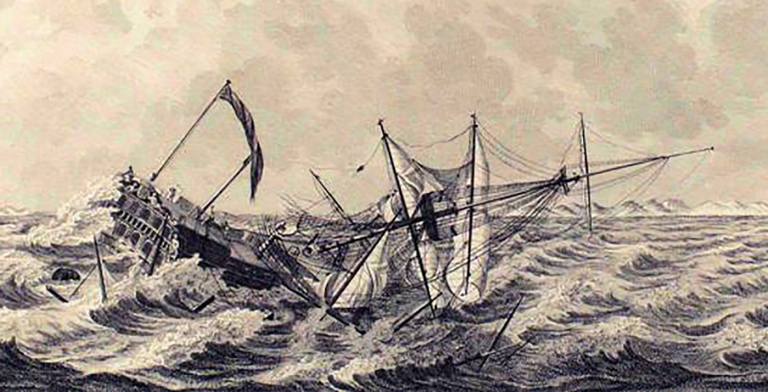
The Haarlem Shipwreck and the 1649 Janssen & Proot Report
On 25 March 1647, the VOC ship Haarlem, commanded by Captain Pieter van der Heyden, anchored in Table Bay to take on fresh water and provisions. A sudden gale drove the vessel ashore, wrecking it on the beach near Blouberg. The strongly built ship held together long enough for the crew to salvage a large part of the Company’s cargo, including pepper, cinnamon, sugar, indigo, linen, and porcelain. [2] [3]
Junior merchant Leendert Jansz took charge of the roughly sixty survivors. Because the area around the wreck was unsuitable for a long stay, they moved to Table Valley, where they established a camp beside a fresh-water stream. They built a small defensive fort named Fort Sandenburg and used timber from the wreck to erect canvas tents to protect the salvaged goods. With no draught animals available, the men hauled the cargo themselves on wagons made by the ship’s carpenters to Salt River, from where it was ferried out to visiting ships. [2] [3]
The castaways planted vegetable seeds recovered from the wreck and successfully grew cabbages, pumpkins, turnips, onions, and other crops. They traded with the local Khoikhoi people, who supplied them with cattle and sheep. The men sustained themselves with fish, penguin eggs, game, and rice obtained from passing vessels. Despite some hardships, they benefited from the mild climate of the Cape spring and summer. They remained at the Cape for just over a year. On 10 March 1648, the ship Gouda, part of a returning VOC fleet, arrived in Table Bay. Jan van Riebeeck was among those on board. He met Leendert Jansz and the other survivors of the Haarlem, including Captain Pieter van der Heyden. While the salvaged cargo was being loaded aboard the relief ships, Van Riebeeck spent several days exploring the surrounding area. He observed the fertility of the soil, the abundance of fresh water, and the plentiful supply of fish and game. In early April 1648 the survivors were finally relieved by the ship Domburg, commanded by Wollebrant Geleynsen. The remaining cargo was transported to Salt River and shipped back to Europe. [2]
On 26 July 1649, Leendert Jansz (Janssen) and Nicholaas Proot submitted a formal report to the directors of the Amsterdam Chamber of the Dutch East India Company. The document, bearing both their signatures, presented a detailed assessment of the advantages offered by Table Valley. Written in a clear and observant style, it reflects the authors’ direct experience of more than eight months’ residence at the site. The report submitted by Janssen and Proot strongly advocated for the establishment of a permanent refreshment station in Table Valley. It emphasized the strategic and practical benefits of such an outpost, particularly when contrasted with the limited resources available at St Helena, and underscored the necessity of a victualing station on the long sea route between the Netherlands and the VOC’s trading regions in the East. Finally, the author expressed surprise that the enemies of the Netherlands had not already formed a outpost at the cape, and with a small war fleet captured all of the Companies ships as they were about to pass. [3]
The memorial was subsequently referred by the Amsterdam Chamber to the Supreme Directory of the Company. After seeking the opinions of the other chambers and receiving their approval, the Supreme Directory resolved on 30 August 1650 to establish the proposed victualling station. Deputies at The Hague were tasked with drawing up a detailed plan and consulted Nicholaas Proot, who was then residing in Delft. Although Proot was offered command of the expedition, he declined the position. On 20 March 1651, the Supreme Directory formally approved the plan and authorized the Amsterdam Chamber to carry it out. In total, nearly twenty months of discussion and bureaucratic deliberation passed before any concrete steps were taken toward realizing the project. [3]
Five days later, instructions were issued to the skippers of the ships Dromedaris and Reiger, and the yacht Goede Hoop. They were directed to sail to Table Bay, where they were to select a suitable site and construct a wooden building near the Fresh River, using materials they had brought for the purpose, to accommodate seventy to eighty men. The Reiger was to proceed to Batavia as soon as her cargo for the Cape had been discharged. The Dromedaris was to remain in Table Bay until the completion of the fort, which was to be named Good Hope. Seventy men were to be left at the Cape. These men were instructed to cultivate gardens and to trade with the indigenous Khoikhoi for cattle. They were strictly ordered not to harm the Khoikhoi or their livestock, A diary of all events was to be kept. [3]
In the face of sharp criticism from the Gentlemen XVII, who charged that the entire administration in the Indies was compromised by private trade, Governor-General Van der Lijn, himself under suspicion, issued strict measures against the practice. One of the first to be proceeded against was Van Riebeeck’s uncle, Gerrit van Harn, who faced specific charges and was dismissed and sent home without rank or salary. The action soon extended to Van Riebeeck, who was recalled from Tonkin together with junior merchant Lambert Heycoop on vague accusations of private trading. No specific evidence was ever recorded against him. He was permitted to return to the Netherlands with his rank and salary intact, indicating that he was likely innocent and had been used as an example to others. [2]
The Directors entrusted Jan van Riebeeck with the report prepared by Janssen and Proot. During the salvage of the Haarlem’s cargo, he had spent three weeks ashore at the Cape while the fleet under Wollebrant Geleynsen was loading the recovered goods. Van Riebeeck shared Janssen and Proot’s favourable assessment of the strategic advantages and agricultural potential of the Cape, but he held a more sceptical view of the character and trustworthiness of the indigenous inhabitants. On 4 December 1651, the Directors resolved that Mr van Riebeeck should have the authority to convene the Broad Council of the ships and preside over its meetings, thereby appointing him commander-in-chief of the expedition. [3]
Jan van Riebeeck Arrives at the Cape – April 1652
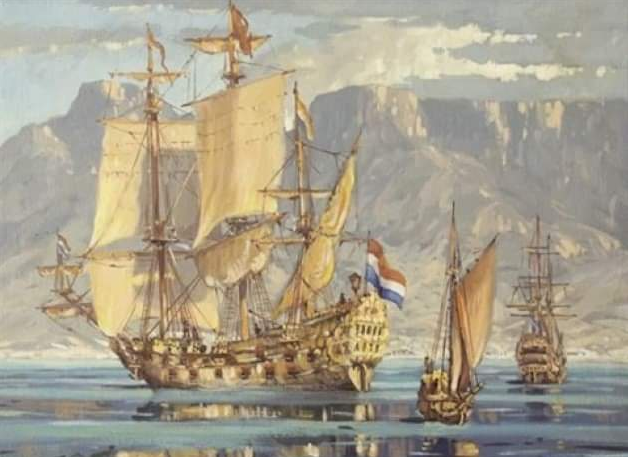
On 5 April 1652, in the mid-afternoon, the chief mate of the Dromedaris sighted Table Mountain rising above the eastern horizon. As the first to spot land, he claimed the sixteen-shilling reward that had been offered. A cannon was fired immediately and signal flags hoisted to alert the crews of the Reiger and Goede Hoop, which were sailing some distance to leeward. During the night, the small fleet closed in on the coast and took up position just south of the entrance to Table Bay. [3]
Dawn on 6 April 1652 broke calm and still. While the ships lay becalmed, a boat was sent ahead carrying bookkeeper Adam Hulster and mate Arent van Ieveren. Their orders were to cautiously round the Lion’s Rump and determine whether any vessels were anchored in the bay. The boat returned about two hours before nightfall with welcome news: the bay was empty. By then a breeze had picked up. The Dromedaris and Goede Hoop stood in toward the shore and, shortly after sunset, anchored in five fathoms of water off the mouth of the Fresh River. The Reiger remained outside overnight. Early the following morning, she entered the bay on a light wind and dropped anchor alongside the other two vessels at eight o’clock. Thus, after a passage of 104 days from Texel, on the morning of Sunday, 7 April 1652, Jan van Riebeeck and his company first set eyes on the site of their new settlement. During the voyage, two lives had been lost aboard the Dromedaris: the young child of the ship’s surgeon, who had his family with him, and a carpenter who was already ill when the fleet departed Texel. [3]
At dawn, Skipper Coninck went ashore to search for letters and to procure fresh herbs and fish. It had long been the custom for captains calling at Table Bay to leave journals, reports, and other documents concealed in secure locations, with prominent stones marked to indicate where they could be found. This practice, observed for nearly half a century, enabled fleets arriving from the Netherlands to receive the latest intelligence from the East. In wartime, due caution was taken to ensure the papers did not fall into enemy hands, but under normal circumstances the system proved both practical and highly effective. [3]
Skipper Coninck went ashore accompanied by six armed soldiers and a boat’s crew equipped with a seine net. They returned with a box containing three letters and a substantial catch of fish. The letters had been written by Jan van Teylingen, admiral of the most recent return fleet from the East. He had sailed from Table Bay on 26 February with three ships out of the eleven under his command; the others had been lost sight of shortly after passing the Strait of Sunda. After waiting eleven days at the Cape, the admiral had proceeded to St Helena in the hope of rejoining the missing vessels. In case they arrived later, he left a letter for their commanders outlining his movements. In it, he reported that he had obtained only one bullock and one sheep from the Khoikhoi, even though large herds of cattle had been observed further inland. He added that the missing ships carried horses intended for the new victualling station, and directed that the animals be landed and placed in the care of a Khoikhoi man who spoke English. The other two letters were addressed to the Governor-General and Council of India and were to be forwarded by the next vessel to call at the bay. [3]
On 8 April, the Council—comprising the Commander and the three skippers—met aboard the Dromedaris to organise the start of shore operations. It was resolved that the men would disembark immediately and mark out the site for the fortress. Excluding officers, the three vessels carried a total of 181 men. Of these, 100 were assigned to constructing the walls. The carpenters were tasked with erecting a temporary wooden dwelling house and storage shed, while those remaining aboard assisted in discharging cargo and catching fish. [3]
That evening, Jan van Riebeeck and a small party went ashore to explore the valley and choose a suitable site for the fort. It was late in the dry season, and the landscape lay parched beneath a lingering drought. The headwaters of the small streams that fed the Fresh River in winter had dried up, leaving their channels cracked and exposed under the sun. The vivid wild flowers that usually transformed the valley and delighted visitors were nowhere to be seen. Although the summer heat had passed, the rains had not yet arrived to revive the earth and restore it to the lush condition described by Janssen and Proot. The stream of fresh water, known to early mariners as the Fresh River, still flowed down the centre of the valley from the mountain to the sea. [3]
After surveying Table Valley, Jan van Riebeeck and the three skippers selected a site for the fort on ground situated just behind the present-day Commercial Exchange. The outlines were marked out immediately, and labourers set to work without delay. The fort was designed as a square with a bastion at each corner, each face measuring 252 Rijnland feet in length. Its walls were constructed of earth, twenty feet thick at the base, tapering to sixteen feet at the top, and stood twelve feet high, surmounted by a parapet. A moat surrounded the entire structure, into which water from the Fresh River could be diverted. Within the fort stood several wooden buildings and a square stone tower that rose only slightly above the walls. The tower featured a flat roof from which defenders could fire down on any attackers attempting to scale the earthen ramparts. These buildings served as living quarters, barracks, and storehouses. On the seaward side, a large area beyond the moat was enclosed by an additional earthen wall to strengthen the defences; this outer enclosure housed the workshops and hospital. At the rear, a similar compound served as a cattle kraal. Although the plan underwent several modifications during construction — particularly concerning the thickness and height of the walls — the general design remained as originally laid out on 9 April. Such was the original Fort Good Hope when completed. [3]
Early Interactions with the Khoikhoi in 1652
When the boat returned, two Khoikhoi came aboard the Dromedaris. One of them was a man who would maintain a close connection with the Europeans for the remainder of his life. He was the same individual in whose care the horses were to have been left, had the missing ships of van Teylingen’s fleet put into Table Bay instead of sailing directly to St Helena. [3]
His native name was Autshumao, but he became better known as Harry, or Herry, as Mr van Riebeeck recorded it. He had previously spent time aboard an English ship, during which he had visited Bantam, and had acquired a rudimentary knowledge of the English language. Although imperfect, this linguistic ability made him useful as an interpreter between the Dutch East India Company and his people. The small clan of which Harry was the leader constituted the only permanent inhabitants of the Cape Peninsula at that time. They possessed no cattle and subsisted precariously by fishing and gathering wild roots. They called themselves the Goringhaikona. They were an impoverished, famine-stricken, and half-naked group whose way of life was among the most wretched imaginable. [3]
There were two larger clans who lived mainly in the interior. The first were the Goringhaiquas, known to the Dutch initially as the Saldanhars and later as the Kaapmans. They were led by Chief Gogosoa, a man of such considerable girth that the Dutch commonly referred to him as the Fat Captain. The second clan were the Gorachouquas, under Chief Choro, whom the Dutch nicknamed the Tobacco Thieves. Both the Goringhaiquas and the Gorachouquas wandered across the countryside with their large herds of cattle. During trading visits they would sometimes pitch their mat huts beside Table Mountain, at the foot of Riebeek’s Kasteel, or in the valley now known as Franschhoek. The Goringhaiquas, being the most numerous and wealthiest of the groups, were regarded by Mr van Riebeeck as having the strongest claim to ownership of the surrounding country. [3]
The Arrival of the Walvisch and Olifant
On 7 May, the ships Walvisch and Olifant dropped anchor in Table Bay. Having left Texel on 3 January, they had lost 130 souls during the voyage. Their crews were in a dreadful state, ravaged by scurvy, when they reached the Cape. On the 11th, the Broad Council met aboard the Dromedaris and resolved that fifty of the weakest invalids from these two ships should be landed and left at the settlement. Provisions sufficient for three months were to be left for their use, and all who recovered were to be sent on to Batavia at the first opportunity. The names of the four ships then in the bay were assigned to the bastions of the still-unfinished fort. The southern bastion was named the Dromedaris, the northern the Reiger, the eastern the Walvisch, and the western the Olifant. The little yacht Goede Hoop gave its name to the fort itself. The ships sailed again as soon as possible. The Reiger departed for Batavia with them, and on 28 May the Dromedaris also sailed, leaving the small outpost to its own resources. [3]
The Hardships of the First Winter Rains
The cold, stormy weather of winter was beginning to set in, and the misery of Mr van Riebeeck and his people increased with each passing day. Rain could not be kept out of the tents and the makeshift wooden buildings they had erected for temporary use, making it difficult to preserve their bread and other perishable stores. With the change in weather came sickness, which the weakened settlers were powerless to resist. Almost every day now brought a death from dysentery or scurvy. By 3 June, out of one hundred and sixteen men, only sixty were still capable of any labour. Fresh meat, vegetables, and proper shelter would have saved many lives, but these necessities could not be obtained. There was little game in Table Valley, although four men who ventured out with guns reported seeing numerous antelopes beyond the mountains. For weeks on end, they encountered none of the other Khoikhoi clans, only Harry’s small group, who proved more of a burden than an assistance. The encampment increasingly resembled a large hospital, where the few able-bodied men staggered about among the sick and the dying. Work on the fort had almost come to a halt, as the settlers struggled merely to care for themselves. [3]
However, the rains that had brought on the dysentery soon brought them relief as well. In an incredibly short time, the grass sprang up as if by magic, along with various nutritious plants. These were all plants with corrective and medicinal properties — exactly what was needed. The sick and feeble moved about gathering wild herbs and roots, declaring that nothing in the world tasted half so palatable. They felt that God had looked down in compassion upon them and relieved them in their great distress. With the grass came game, both large and small, although the settlers had not yet become skilled hunters. As soon as the first showers fell, a piece of ground was prepared, and Hendrik Boom, the gardener, planted seeds. Soon the sick were enjoying fresh delicacies such as radishes, lettuce, and cress. They also found suitable reeds for thatching. Once the buildings were properly roofed with these reeds instead of boards and torn sails, they were able to withstand the heavy rains with far greater success. [3]
During the winter, heavy storms brought torrential rains, flooding the valley on several occasions. The ground prepared for gardens was washed away twice. Yet as soon as each storm passed, the settlers returned to work and laid out fresh plots for cultivation. The surrounding land was now teeming with game — elands, hartebeests, and steenbok — but the hunters, armed with their clumsy firelocks, could rarely get within shooting range. Jan van Riebeeck ordered pitfalls to be dug and snares to be set, but these efforts proved largely in vain. Throughout the entire season, only one young hartebeest was secured, and that was run down by dogs. Once the workmen regained some strength, work resumed on the fort and the buildings within its walls. By the 3rd of August, the whole party had found shelter inside the fortification. The heavy rains were found not to damage the earthworks in the least, for the walls had been faced with sods as soon as the ground was soft enough to cut them. [3]
Sick Visitors, the First Birth, and Church Discipline at the Cape
Those were the days when the observances ordinarily associated with a profession of religion were strictly adhered to. No one was permitted to be absent from public prayers without good and sufficient reason; yet at the same time, no one was allowed to worship God publicly in any manner other than that which the government approved. Religious phrases were constantly on people’s lips, and their correspondence was filled with quotations from Scripture and ejaculatory prayers. Much of this was mere formality, comparable to the phrase “God save the Queen” that appears at the foot of a modern proclamation against evading customs. Nevertheless, it is certain that matters connected with public worship occupied far more of the people’s attention at that time than they do today. [3]
In its most prosperous days, the Netherlands East India Company provided for the religious needs of its servants in a very liberal manner. Its largest ships and most important settlements were furnished with chaplains paid from company funds. Smaller vessels and outlying stations, such as the Cape in the early years after its establishment, were served by officers known as Comforters of the Sick, or Sick Visitors. These men performed duties similar to those of catechists in the English Church and evangelists in various Presbyterian bodies. They instructed the children, conducted religious services, and read Scripture, but were not permitted to administer the sacraments. [3]
A Sick Visitor named Willem Barentsz Wylant arrived in South Africa aboard the Dromedaris with Jan van Riebeeck. His family was the first to be assigned quarters within the walls of the fort. There, on the 6th of June, his wife gave birth to a son — the first child of European descent born in the colony. Chaplains from visiting ships conducted services during their stay and usually administered the sacraments. Mr. Backerius, chaplain of the Walvisch, is the first on record to have done so in South Africa. It is possible, however, that the Haarlem had a clergyman on board, in which case the full rites of the church would certainly have been observed while its crew remained in Table Valley. [3]
The duties of the Sick Visitors were strictly defined, and in the Company’s service no one was permitted to exceed his assigned sphere of labour. Everyone had his appointed place, understood it, and was expected to remain within it. During the time of greatest hardship, one Sick Visitor took it upon himself to address the people in his own words rather than reading a printed sermon, as he was required to do. In the following year, reports of this irregularity reached Batavia and came to the attention of the clergy there. Although no objection was raised to the doctrines he preached, the fact that an unordained man had presumed to address a congregation was considered a scandal to the Christian church. The Ecclesiastical Court of Batavia petitioned the Governor-General and Council of India on the matter. A despatch was promptly sent to Jan van Riebeeck instructing him to prohibit such irregular proceedings. A letter from the Ecclesiastical Court was also sent directly to the commander, in which it was stated that the Sick Visitor should have known better than to “put his sickle into another’s harvest” and assume honour that did not belong to him. This incident demonstrates the great importance the Dutch clergy of the time attached to strict adherence to established church order, and their strong opposition to any form of innovation. [3]
Forest Exploration, a Failed Desertion, and the Enforcement of Discipline
During their survey of the interior, van Riebeeck and his party explored the forests that then extended along the base of the mountains and deep into the kloofs. They found trees of impressive size, some exceptionally straight and well suited for use as ship masts. The variety of timber was considerable. Van Riebeeck noted that these forests had clearly been visited long before; several trees bore dates carved into their trunks—1604, 1620, and 1622—although no names or initials accompanied them. [3]
Towards the end of September, four men slipped away from the fort intending to travel overland to Mozambique, from where they hoped to secure passage back to Europe. So little did they understand of the vast distance or the perils ahead—or so desperate had their circumstances become—that they set out with only four biscuits and a few fish. Following Dutch custom, the leader maintained a diary of their journey, written in red chalk. It opened with the words “In the name of the Lord Jesus Christ” and recorded their encounters with wild animals and their belief that God had preserved them. After eight days, Willem Huytjens, Gerrit Dircksen, and Jan Verdonck could go no further. Their leader, Jan Blanx, realising he could not continue alone, abandoned the attempt. The entire party returned to the fort and surrendered, pleading for mercy. [3]
At the time, van Riebeeck had become aware of a growing spirit of discontent among the workmen. They had been anxiously awaiting the 1652 outward-bound fleet for relief, but it now seemed certain the ships had passed them by. Despair was spreading. Believing that strict discipline was essential in such conditions, van Riebeeck ordered the arrest and trial of several men who had made reckless statements bordering on sedition. The return of the four fugitives gave him particular satisfaction. All four pleaded guilty and begged for clemency. They were sentenced to two years of hard labour in chains, while their leader received severe corporal punishment. The latter part of the sentence was carried out, but on New Year’s Day the men were released after promising to conduct themselves properly in future. [3]
The Northern Voyage of the Goede Hoop and the Claim on French Sealskins
In late winter, the yacht Goede Hoop, which had lain idle for months and had several times narrowly escaped being driven ashore during gales, was prepared for a short voyage northward. At this stage, van Riebeeck and the Council had only a limited knowledge of the south-west coast of Africa. They discussed the possibility of obtaining gold, ambergris, musk, and ivory through trade at Saldanha Bay. They were at least confident that local inhabitants would be found there, since Admiral Joris van Spilbergen had reported seeing the smoke of many fires inland when he passed in November 1601. From Spilbergen’s journal they also learned that he had encountered large numbers of seals and coneys on Dassen Island. In addition, Skipper Simon Pieter Turver had heard a French captain at St Helena boast that a cargo of sealskins and oil taken on this coast was worth 100,000 guilders. [3]
The yacht was delayed by contrary winds until 21 October, when she sailed from Table Bay on a fair breeze and, within a few hours, anchored off Ilha Elizabeth, also known as Dassen Island. The skipper, accompanied by a party of sailors and the clerk Frederick Verburg, went ashore. It was evident that the island had been used as a sealing station very recently. Huts constructed of sealskins stretched over whale ribs were still standing, together with the tools of the trade. The men declared the flesh of the young seals to be the most delicious meat they had ever tasted. They observed vast numbers of seals and innumerable seabirds, from which they collected about 12,000 eggs before sailing on to Saldanha Bay. [3]
The description they left of this splendid sheet of water is reasonably accurate, although they believed a large river emptied into its southern end. The bay extended so far inland that they were unable to explore it fully. A few impoverished Khoikhoi, similar to Harry’s beachcombers, were found living along the shores, but no pastoral Khoikhoi with cattle were present at the time. After several days, however, a group of herders arrived and bartered two sheep. Beyond these animals, a handful of ostrich feathers, and three antelopes killed with arrows, almost nothing could be obtained in trade. Fish were caught with a seine net, and the bay’s advantages for fishing were duly noted. [3]
Well supplied with venison, fish, and eggs, Skipper Turver decided it was prudent not to slaughter the two sheep. Instead, he landed them on Schapen Island so they could graze until needed. While exploring the island, the men discovered a large heap of dried sealskins. Upon examination, more than 2,700 were found to be in excellent condition, with only those on top slightly damaged by weather. Scattered tools and other articles indicated that a French ship had recently been there and intended to return soon for another cargo. Turver concluded that, now that the Netherlands East India Company had established a fort at the Cape, it was entitled to the exclusive benefit of this resource. He therefore loaded all the usable skins into the yacht and erected a marker of possession on behalf of the Company at the site. Thereafter, the Goede Hoop examined the coast around St Helena Bay, revisited Dassen Island, and returned safely to her anchorage off the fort on 14 November. [3]
Arrival of the Kaapmans and the Opening of Trade with the Khoikhoi
Around the beginning of October, the fires of the Kaapmans became visible far to the northward. On the 9th of that month, two of their scouts arrived at the fort with news that the entire clan, together with its flocks and herds, was approaching. Van Riebeeck responded heartily, “God grant it. Amen.” The two strangers were far finer specimens of the Khoikhoi than the famine-stunted beachcombers the settlers had previously encountered. They were naked but each carried a prepared skin kaross draped over one arm, much as a European gentleman of the period would carry his cloak. For ornaments they wore solid ivory armlets and various copper decorations. The commander had strict orders to conciliate the indigenous inhabitants, and his own necessities at the time were so pressing that — quite apart from duty — he was compelled to show them every mark of friendship. Provisions brought from the Netherlands were running low, and many months would pass before the return fleet could be expected. The very survival of the settlement might depend on obtaining a supply of livestock. The visitors were therefore treated with the greatest hospitality. They were shown the stores of copper plates, brass wire, and tobacco that had been brought for trade, and when they left they carried presents and messages of friendship with them. [3]
The Kaapmans were moving slowly with their cattle, as was their custom, shifting to new pastures only once the grass in one area had been grazed bare. Their scouts and messengers visited the fort frequently thereafter, but it was not until the 20th that they brought anything for barter. On that day the trade of the season began when van Riebeeck obtained, in exchange, three head of horned cattle, four sheep, three ivory tusks, and two young ostriches. Shortly afterwards the main body of Gogosoa’s people reached the peninsula, and thousands of cattle could be seen grazing within sight of the fort and around the back of the mountain where the modern suburbs of Rondebosch and Claremont now stand. Europeans and Khoikhoi met openly and appeared to be on good terms, yet there were clear signs of mutual suspicion. Van Riebeeck doubled the guards at the fort for as long as the Kaapmans remained in the neighbourhood. Small parties of Europeans were often met with fear, the Khoikhoi scattering at their approach. [3]
A brisk trade nevertheless developed, and van Riebeeck soon had the satisfaction of acquiring a substantial herd. All private trade between the workmen and the natives was strictly prohibited. The commander conducted the trade himself, assisted by one of the clerks — either Verburg or van der Helm. Horned cattle were exchanged for brass wire, and sheep for tobacco, so that bartering largely consisted of agreeing the quantities of these goods. The Khoikhoi also brought ostrich eggs, tortoise shells, and occasionally a few ostrich feathers, which the men were eager to obtain in return for small pieces of tobacco. Van Riebeeck threatened severe punishment for anyone who infringed his regulations. He had no intention of allowing anything that might interfere with the Company’s trade, and he also feared that the sailors and soldiers might inadvertently provoke a quarrel with the very people he wished to conciliate. He believed that large quantities of ivory and ostrich feathers might eventually be obtained if the Khoikhoi could rely on a safe and steady market. However, he soon discovered that they were too indolent to hunt elephants and ostriches specifically for this purpose and only brought what they happened to find. It was not within his power to create among them new wants that would induce any unusual exertion. [3]
In December, the Kaapmans set fire to the dry grass throughout the surrounding countryside, sparing only the pastures that van Riebeeck had asked them to preserve for his own use. They then moved away from Table Valley with their herds. Before departing, they made a proposal that starkly illustrated the warrior culture and inter-clan rivalries of the Khoikhoi. They invited the commander to join them in an attack on their enemies, offering him all the spoils in return for his assistance. Van Riebeeck replied that he had come to trade peacefully with all peoples and therefore declined to involve himself in their disputes. Although he maintained the outward appearance of dealing justly and amicably with everyone, his private correspondence reveals that he would have been ready to act differently had he not been strictly bound by the directors’ orders. [3]